If you raise goats, late October is the middle of the busiest window of the year. Most breeds cycle as the days get shorter, and fertility peaks from late September through November, so the decisions you make in the next few weeks set your kidding dates, your kid crop and your workload next spring.
This year there’s an extra factor for southern herds. New World screwworm, a fly whose larvae feed on living tissue, has been confirmed in Texas, and on October 21, 2026 USDA reported the first U.S. case in wildlife: an elk on a game ranch in Pecos County. That doesn’t change how goats breed, but it should change how you plan kidding season.
Below is a practical checklist for getting does and bucks ready, reading heat, picking your kidding dates, and keeping newborns safe.
When is goat breeding season, and how do you pick kidding dates?
Most goats are short-day breeders. Oklahoma State University’s meat goat handbook puts the season at August or September through January, with October to December as the peak. Missouri Extension notes that some breeds also cycle in spring, but for most U.S. herds fall is when breeding happens naturally.
Gestation runs about 150 days, so pick your kidding month first and count backward:
| Buck goes in | Kids due around |
|---|---|
| October 15 | Mid-March |
| November 1 | Late March |
| November 15 | Mid-April |
| December 1 | Late April |
Think about three things when you choose. First, weather: where will kids be born, and can you keep them dry and out of the wind? Second, feed: spring pasture growth is the cheapest milk-maker a doe can get. Third, labor: you’ll want to check the kidding pen several times a day for two or three weeks, so pick a stretch when you can actually be home.
In Texas and other warm southern areas, add screwworm to that list. More on that below.
Get your does in condition before the buck goes in
Thin does conceive less reliably and carry fewer kids. University of Missouri Extension recommends a body condition score (BCS) of about 3 on a 5-point scale at breeding, rising gradually to about 3.5 by kidding.
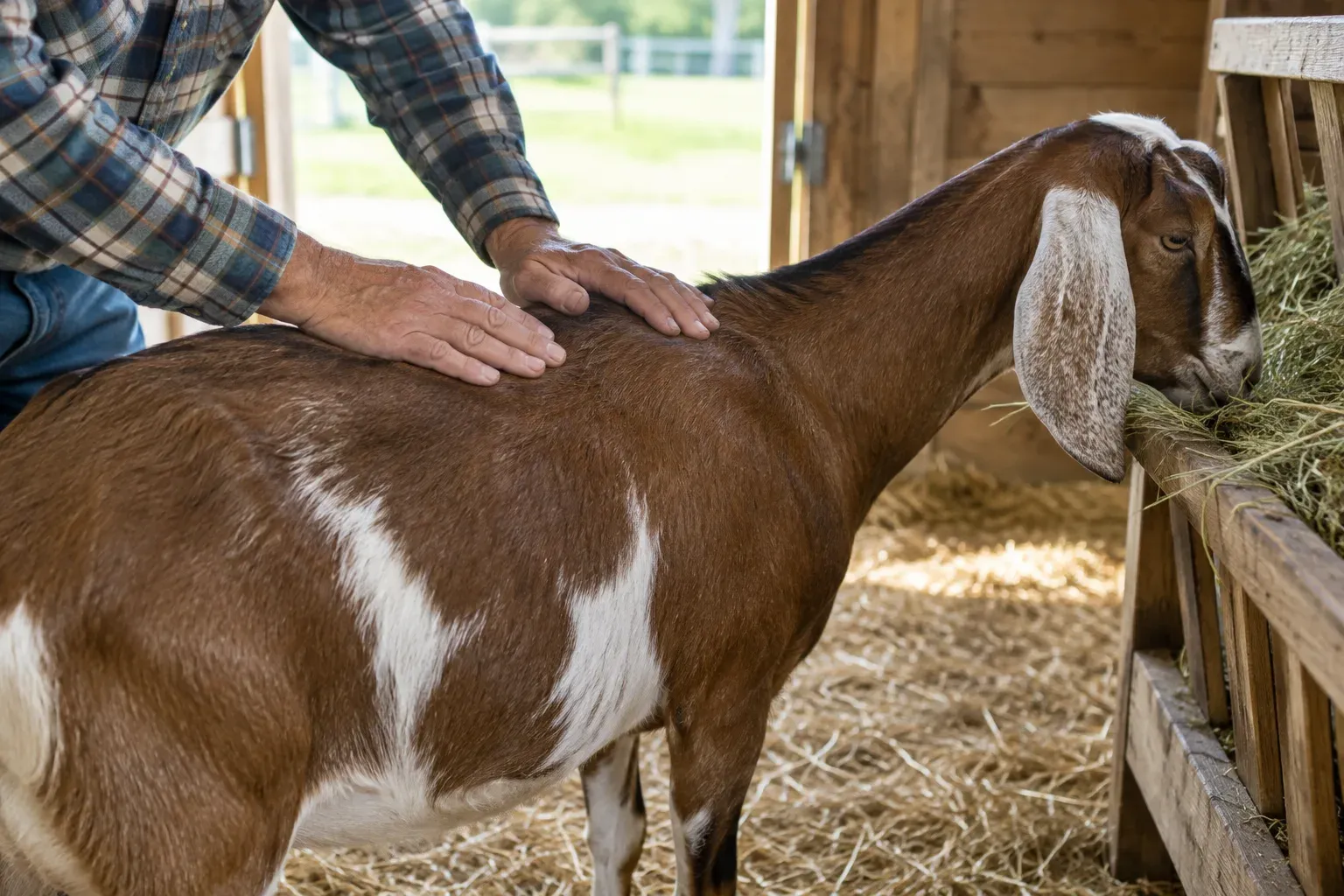
To score a doe, feel along her spine behind the shoulder and over the short ribs. At a 3, the spine is smooth and rounded and you can feel each rib with light pressure. If the spine feels sharp and you can grab the ribs easily, she’s thin. If you have to press hard to find bone, she’s heavy.
Flushing. For does that are a little thin, flushing can help. The idea is to raise their nutrition just before and during breeding so they’re gaining condition when they’re bred. The Missouri guide suggests starting 3 to 4 weeks before the buck goes in and continuing through one heat cycle, using about ¾ to 1 pound of whole corn per head per day or a move to high-quality pasture. Two cautions from the same source: only flush animals that need it, since overfeeding fat does doesn’t help, and be careful with heavy clover or alfalfa, whose plant estrogens can interfere with heat and fertility.
Young does. Oklahoma State says doelings reach puberty around 7 to 10 months depending on breed and feed, and should be bred once they reach 60 to 75 percent of their adult weight. Size matters more than age, so weigh doelings instead of going by birthday.
Before breeding, also:
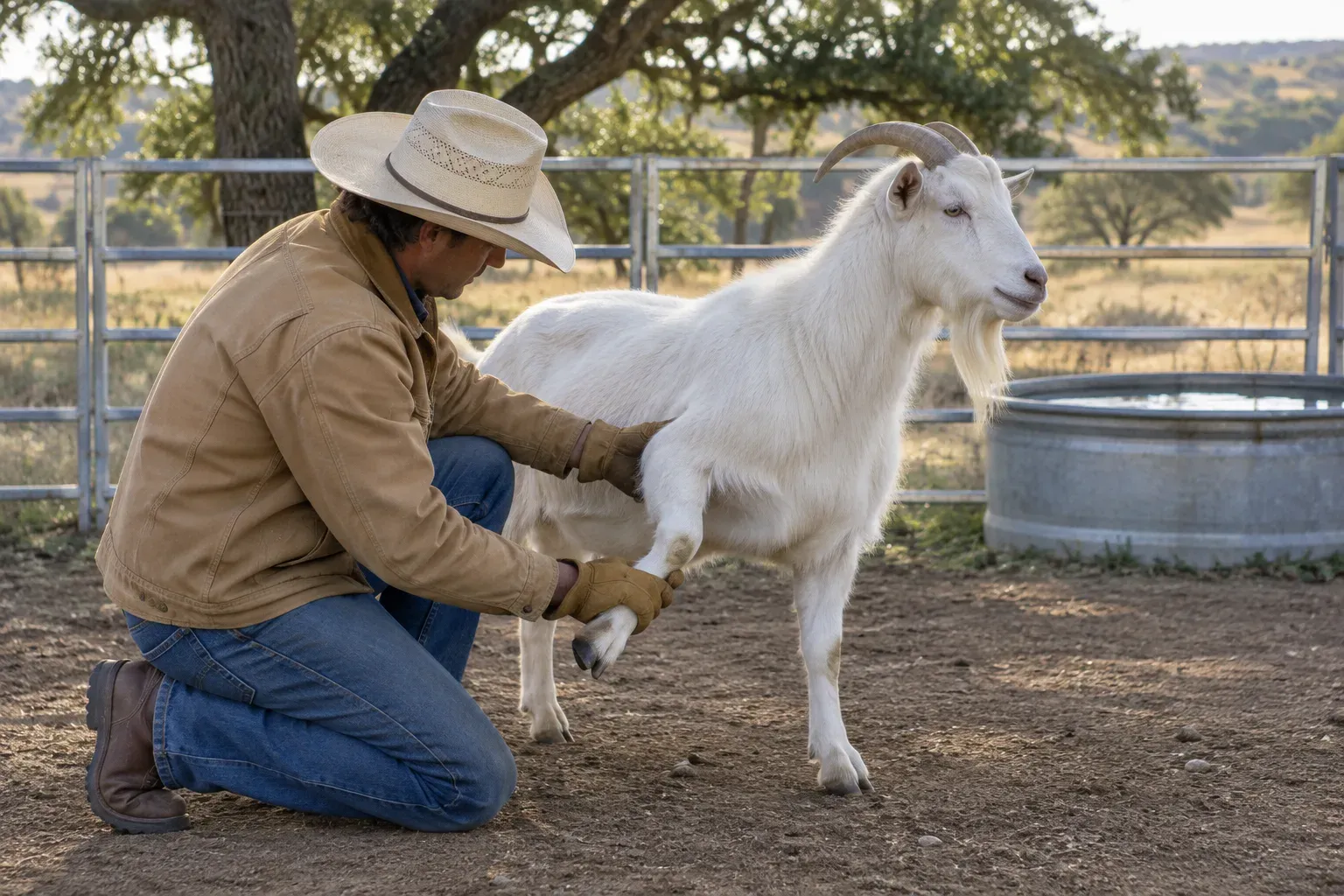
- Trim hooves now. It’s much harder on a heavily pregnant doe.
- Run fecal egg counts or FAMACHA checks with your vet and deworm only the animals that need it.
- Pull does with chronic mastitis, poor mothering records or repeated kidding problems from the breeding group.
Make sure your buck can do the job
A buck is half of your herd’s genetics and, in a small herd, all of the risk. Missouri Extension points out that bucks are often the most neglected animals going into the season, even though they lose a lot of weight during breeding.
Feed him early. Bucks need their nutrition raised for 6 to 8 weeks before mating, to a body condition score of 3 to 3.5. The goal is fit, not fat. The Missouri guide suggests about 0.5 to 1 pound of grain supplement per day on top of good forage, adjusted to his condition.
Get a breeding soundness exam (BSE). A vet checks his overall structure, examines his reproductive organs, measures scrotal circumference and evaluates a semen sample. Oklahoma State’s handbook lists targets of 25 to 28 cm of scrotal circumference for dairy bucks and 26 to 29 cm for meat bucks at 100 pounds, at least 70 percent motility and at least 80 percent normal sperm. If a buck fails, the Missouri guide recommends retesting 30 to 60 days later, so book the exam well before you need him.
Know his workload. A full-grown, healthy buck can easily cover up to 50 does, according to Oklahoma State. Bucklings can start as herd sires at 8 to 10 months but should be used more lightly. Never breed a buck back to his own daughters.
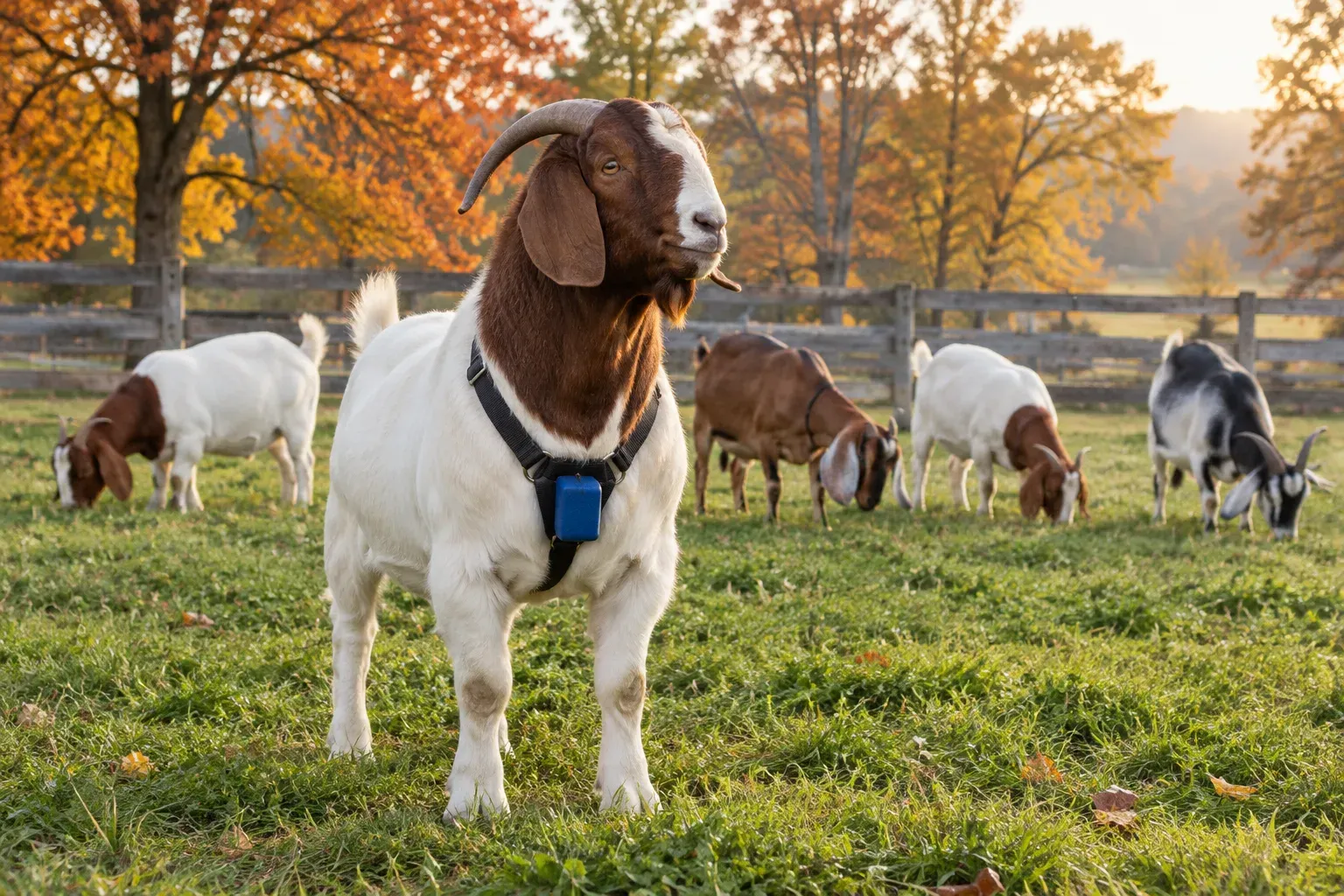
Use a marking harness. A harness with a crayon on the buck’s chest marks each doe he mounts. Change the crayon color about every 18 to 22 days, matching the heat cycle. If a doe gets marked again in the new color, she didn’t settle the first time, which gives you early warning about a problem doe or a problem buck.
Leasing or borrowing a buck? Protect your herd first
Many small herds don’t keep a buck. Leasing one, borrowing a neighbor’s or using a stud service is cheaper, and it brings in new genetics. It also brings in someone else’s diseases.
Caseous lymphadenitis (CL) and caprine arthritis encephalitis (CAE) are two of the diseases most often introduced with new goats, according to Alabama Cooperative Extension. Both are long-term problems that are very hard to clear once they’re in a herd. Before any buck comes onto your farm, or before your does go to his:
- Ask for recent herd test results for CAE and CL. Many breeders also test for Johne’s disease. Ask your vet which tests make sense in your area.
- Look the buck over for abscesses, scars, lameness and parasite load.
- Get a written agreement that covers the fee, how long he stays, who pays the vet if something goes wrong, and whether there’s a free repeat breeding if does come up open.
- Keep a visiting buck in an isolated pen for at least 30 days before he mixes with your herd, which is the minimum Alabama Extension recommends for any new animal.
If you’re looking for a proven buck nearby, the Breedlink app lets owners list bucks with their health records and terms, so you can compare before you call anyone.
How to tell a doe is in heat
A doe’s cycle runs 18 to 22 days, and she’s receptive for about 12 to 36 hours, according to Oklahoma State. That’s a short window, so learn the signs:
- Flagging: fast, repeated tail wagging
- A swollen vulva
- Mounting other does or standing to be mounted
- More activity, restlessness and extra bleating
- A drop in milk yield if she’s milking
Oklahoma State notes that the buck’s presence itself helps bring does into heat. If you hand-breed, put the doe with the buck when she’s showing strong signs, then watch for her to come back into heat 18 to 22 days later.
The screwworm factor for 2026 kidding
New World screwworm flies lay eggs in open wounds and natural openings. The larvae feed on living tissue, and an untreated infestation can kill an animal. USDA describes the current risk to U.S. animals as very low, but the disease is reportable and the agency has been adjusting the Texas infested zone as recently as October 23, 2026.
Breeding itself doesn’t create risk. Kidding does. Penn State Extension lists untreated newborn navels, retained placentas and uterine prolapse among the risk factors, along with wounds from castration, disbudding, tail docking and injuries from fences or equipment. So the planning happens now, while you choose kidding dates:
- Schedule wound-creating jobs for cooler weather where you can, as Penn State recommends. That includes disbudding and castration.
- Treat every navel promptly after birth, using the method your vet recommends, and check it daily until it’s dry.
- Plan a clean kidding area with no sharp edges, loose wire or broken boards.
- Inspect daily during kidding season for any wound that grows, smells, or has maggots, and for animals that isolate themselves or keep licking or biting at one spot.
- Know who to call. In Texas, report suspected cases to your Texas Animal Health Commission region office or the state veterinarian on call at 1-800-550-8242. Elsewhere, call your vet or state animal health official.
If you’re in the Southwest, it’s worth talking to your vet now about whether a slightly earlier or later kidding window makes sense for your farm.
Health and welfare: when to call your vet
Breeding season is a good time to set up your vet relationship if you don’t have one. Penn State notes that a valid veterinarian-client-patient relationship is what gets you fast help and treatment options if screwworm or another outbreak hits your area.
Plan these with your vet before kidding:
- CDT vaccination for pregnant does about four weeks before kidding, so kids get protection through colostrum, according to Michigan State University Extension. Kids then get their own first dose at 6 to 8 weeks of age and a booster 3 to 4 weeks later.
- A pregnancy check by ultrasound if you need to know which does settled.
- A kidding plan: what’s normal, how long to wait before helping, and when to call.
Call your vet right away if a doe is off feed late in pregnancy, has a discharge that smells bad, strains hard without making progress, or if any animal has a wound that isn’t healing.
Bottom line
Fall goat breeding comes down to timing and condition. Pick a kidding month that fits your weather, feed and schedule, get does and bucks to a body condition score around 3, test your buck and any buck you borrow, and use a marking harness so you know who settled. In 2026, add one more item: plan kidding so every navel and every wound gets checked, especially if you’re in Texas or nearby.